Case studies and examples

Four written case studies from recent engagements, six examples of the work across the Microsoft and Google ecosystems, and two tools you can see.

Specialty Retail / Small BusinessAI Implementation

Custom AI Customer Service Agent for Wood Thumb, a San Francisco Woodshop

Wood Thumb, a San Francisco woodshop and design studio, was evaluating off-the-shelf customer service chatbots running $79-$165/month, tools that weren't purpose-built for their business and required ongoing SaaS subscriptions. Our team designed and built a custom AI agent integrated with their website and Gmail, using the Anthropic API with a FastAPI backend. The agent handles customer inquiries, appointment context from their scheduling system, and common questions about services and lead times: all trained on the shop's actual voice and offerings. The result: a purpose-built solution for roughly $5-20/month in API costs, with full ownership of the tool and no vendor dependency.

~$1,740/yr
Annual savings against the commercial alternatives
100%
Custom to their voice, workflows, and data
$0
Vendor lock-in, since they own the code
Mechanical Engineering / Plumbing DesignAI Implementation

Plumbing Takeoff Tool for a Mechanical Engineering Firm

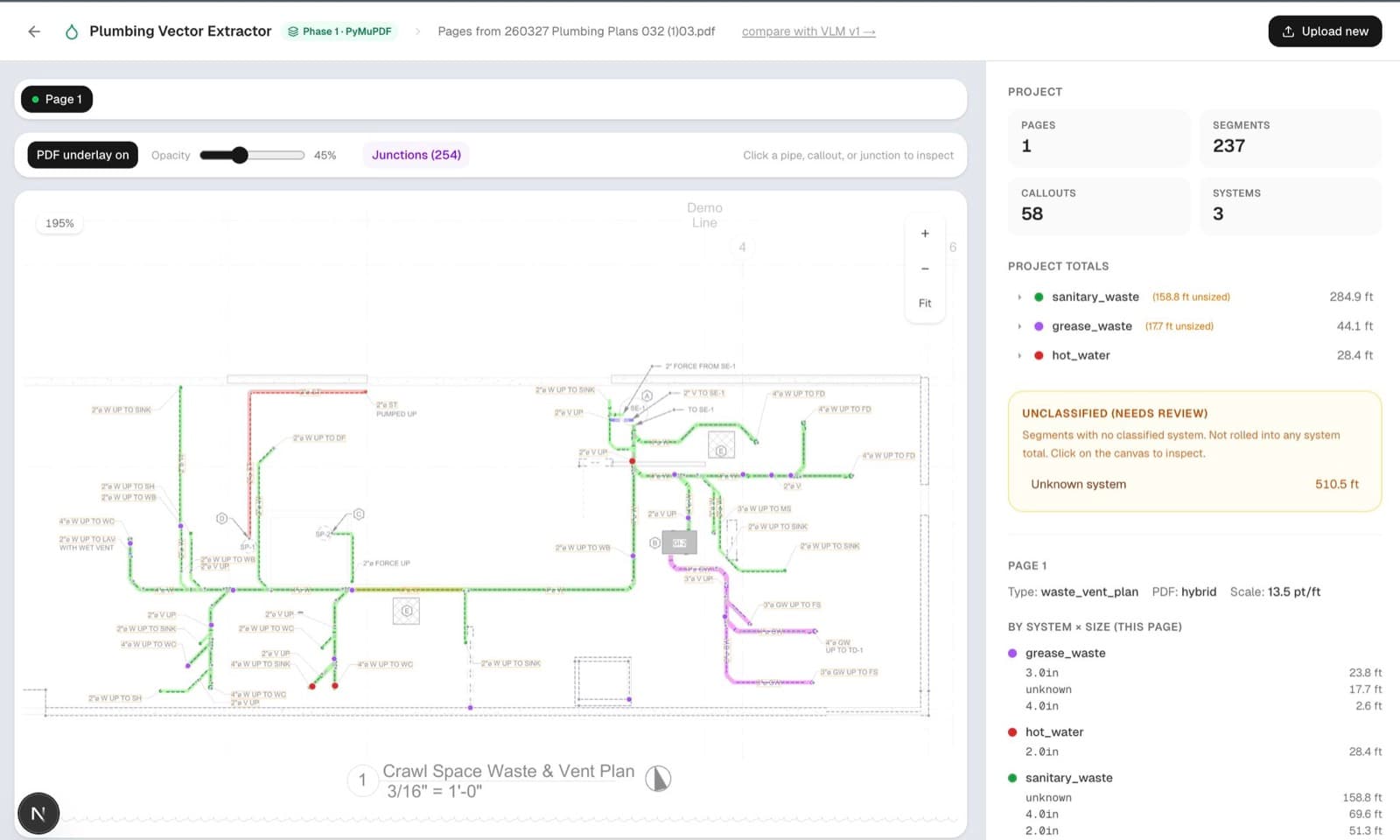
A mechanical engineering firm was taking off plumbing by hand: tracing each sheet for pipe runs, reading sizes off the callouts, and tallying lengths by system into a spreadsheet, a job that ran for weeks across a project. We built a takeoff tool that reads the plan PDF, extracts every pipe segment as a vector with its length and size, reads the callouts, and totals the runs by system, such as sanitary waste, grease waste, and hot water. The extracted lines sit over the original drawing, the engineer clicks any pipe, callout, or junction to inspect it, and segments the tool cannot classify are held out for review rather than rolled into a total. The engineer's time on each sheet now goes to reviewing the extraction rather than tracing it.

237
Pipe segments extracted from a single sheet, with lengths and sizes
By system
Totals for sanitary waste, grease waste, and hot water, by pipe size
Every segment
Inspectable and reclassifiable on the drawing, with unclassified runs held for review
AEC Technology / Design IntelligenceAI Product Strategy

Aané: AI-Powered Architectural Detail and Material Search

Partnered with Aané (aane.io), an early-stage AEC software company building an AI-powered architectural detail and material search platform. The core problem: architecture firms were losing institutional knowledge when project teams turned over, and spending hours re-researching details and materials they'd already solved. We contributed to product strategy and ICP positioning: helping the team articulate why 'reduce research time by 80%' is the right lead metric, and how to sequence onboarding to demonstrate value before asking for firm-wide adoption. The platform now serves architects, interior designers, and engineering firms as a searchable knowledge repository with AI-enabled design intelligence.

Visit aane.io
80%
Research time reduction, the core product claim
3 ICPs
Architects, interior design firms, engineering teams
1 metric
Time to value as the positioning anchor
AEC Industry IntelligenceData Engineering + Live Dashboards

AEC Hub Data Intelligence Platform

Built and maintain 7 live data dashboards pulling from BLS, FRED, Census Bureau, FHWA, and USAspending.gov, covering construction employment, material prices, building permits, bridge conditions, federal infrastructure spending, site risk, and AEC salaries across 44 occupations and 393 metro areas. Each dashboard is validated against source data, updated automatically, and built to serve real decisions, not just display numbers. The platform now attracts AEC professionals, researchers, and firms using it as a primary reference for market intelligence.

7
Live data dashboards
12,393
Salary records across 44 roles and 393 metros
6
Federal and public data sources integrated
Six examples across the Microsoft and Google ecosystems

Each starts from data the firm already has and ends with a person checking the output. The AI implementation page describes how we plan and staff this work.

Firm data

A data lake on Microsoft Fabric

Project, financial, and staff data live in separate systems and arrive messy: a title stored as an ID, a timesheet line without a project. We pull it into one lake on Fabric, clean it in layers, and build dashboards on project health, utilization, and finance, so partners see burn rate per phase in a week instead of at closeout. Once the trusted layer exists, Copilot can answer questions against it.

How the layers work

Microsoft 365

Copilot set up so it finds your answers

Out of the box, Copilot found a reimbursement figure in a travel policy and missed the employee definitions in the handbook. We test retrieval on your own documents, set up Purview labels and security groups so it only sees what each person may see, and roll it out in waves with champions per studio.

The governance steps

Google Workspace

An email draft assistant, as a small example

For a customer-facing business on Gmail we built an assistant that reads incoming mail, checks the calendar, looks up real prices and policies, and writes a reply draft in the company's voice. A person sends every one. Code took two days, and the six knowledge documents and the weekly tuning loop are what make it accurate. The same shape fits a firm's RFI log or client inbox.

The case study

AEC Hub Platform

Firm knowledge and project knowledge, in one assistant

The platform connects a firm's models, project mail, standards, and proven workflows so an assistant can answer with citations, run checks against the model, and draft from the project record. It is how we show what firm-level and project-level context does to an answer.

See the platform

AEC Hub Proposals

Proposal drafts grounded in your past work

Proposals draws on approved firm language, project experience, and staff qualifications to draft against a solicitation, with unresolved facts left visible rather than invented. Firms evaluating vendor proposal generators use it to see what a grounded draft looks like before paying for one.

See Proposals

Custom tools

Claude rules and skills for firm practice

In side-by-side tests Claude did better than ChatGPT on most firm tasks. We set up shared rules and skills so proposal language, report structure, and QA checklists are the same for everyone, instead of living in one person's prompts.

The Claude field guide

Concrete examples.

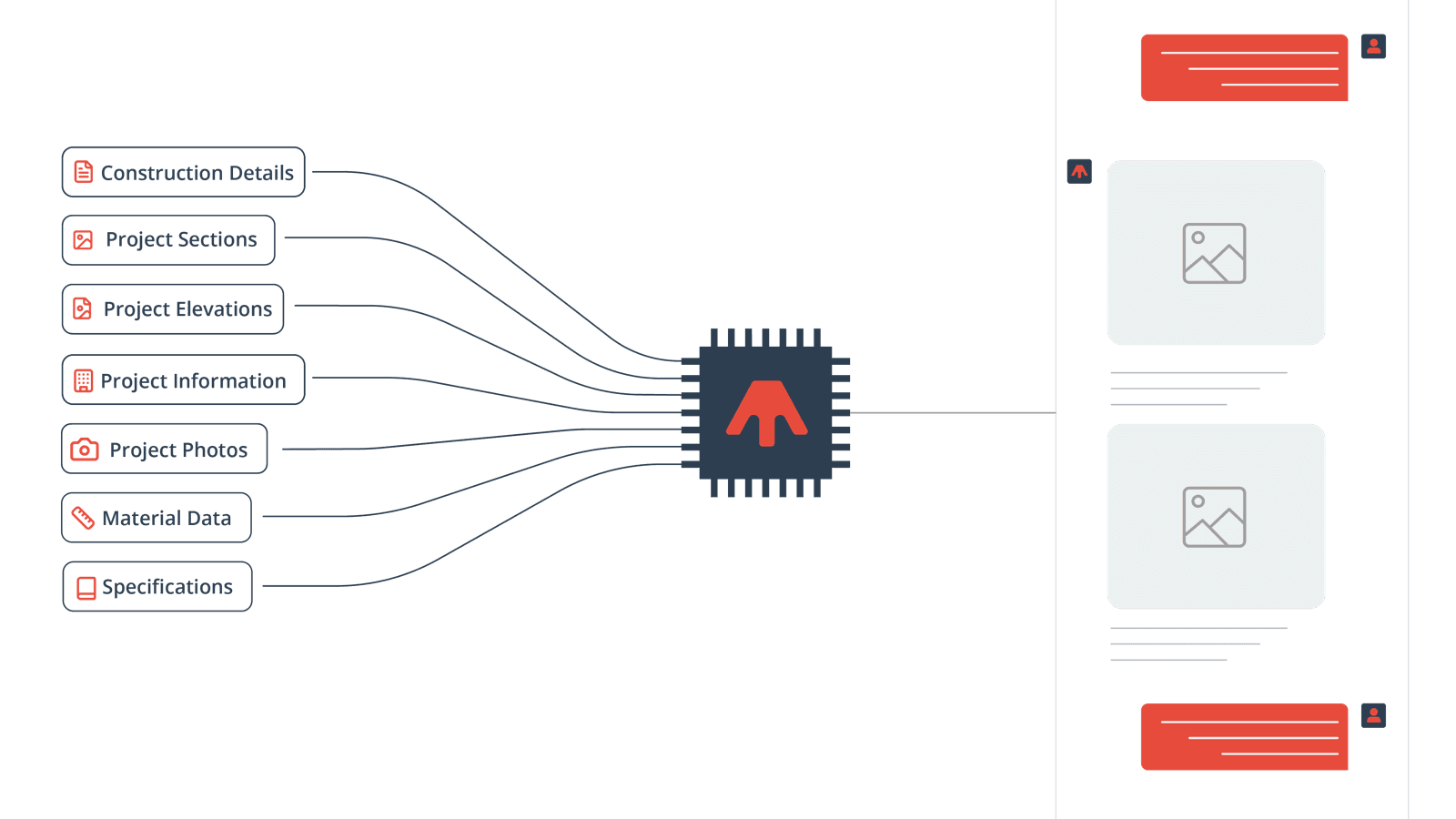
Aané diagram showing firm knowledge sources feeding an AI search interface

AEC Hub tool

An intelligence layer over firm knowledge

Aané connects a firm's construction details, sections, elevations, specs, and photos into one searchable knowledge base, deployed inside a national engineering firm today.

See the Aané review

* Built by Akhil Hemanth

Plumbing takeoff tool showing extracted pipe systems with lengths by size

Built for a client

Weeks of manual takeoff, done in minutes

A plumbing takeoff tool built for an engineering client who was scanning plans by hand for pipe lengths and sizes. Every segment stays reviewable: the engineer can inspect, verify, and reclassify anything on the plan. Never a black box.

Ask about custom builds

* Built by AEC Hub

We also work with AEC technology companies on product, data, automation, and strategy.

Selected work with technology companies

Have a similar challenge?

Start with a free intro call to discuss your firm's situation.

Get in touch