Acoustic Index Reverberation Calculator
AnalysisBrowser calculator estimating reverberation time by octave band with Sabine and Eyring
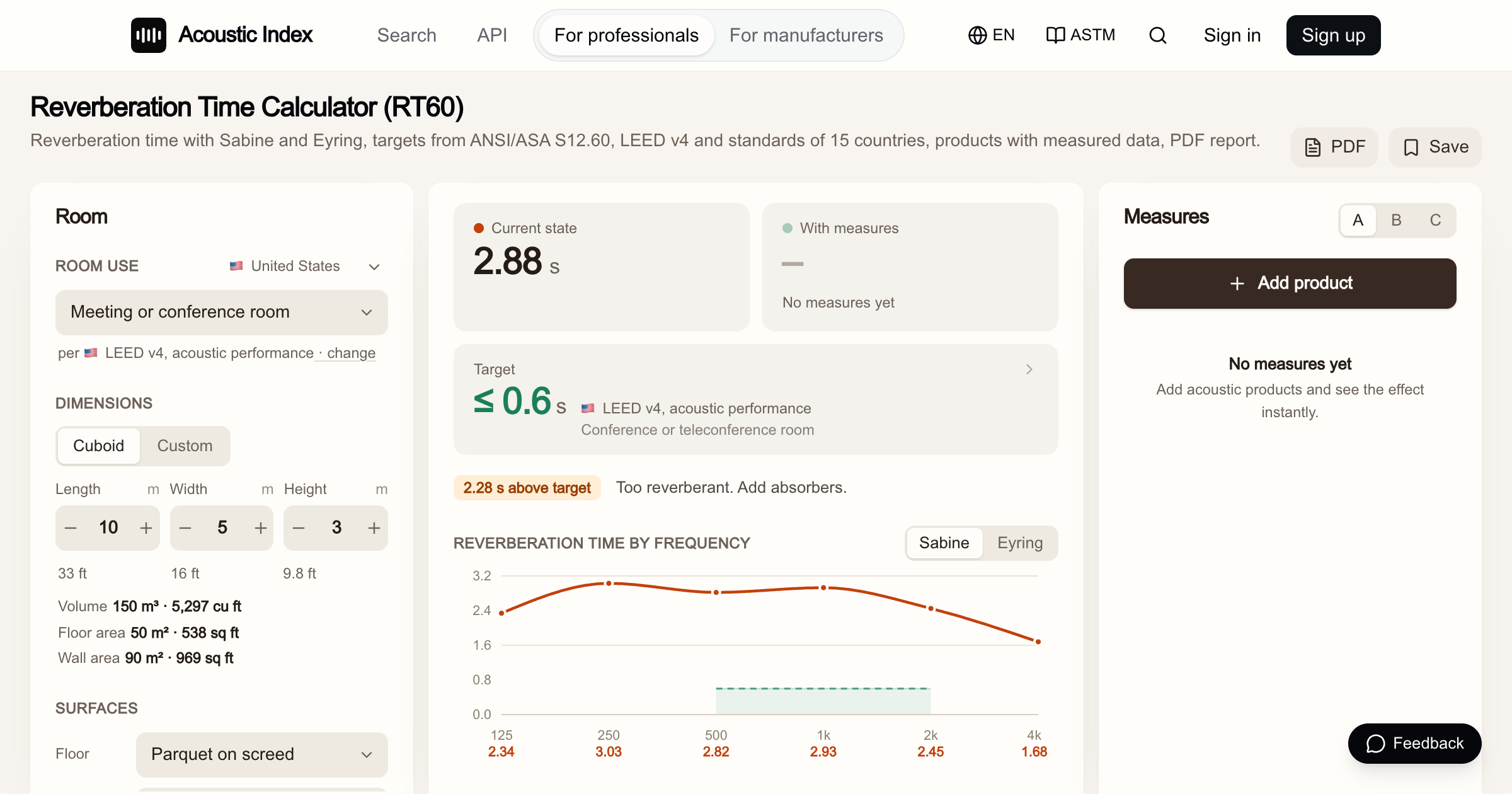
What is Acoustic Index Reverberation Calculator?
A browser-based reverberation time calculator from Acoustic Index, a database of acoustic product measurement data. You enter room dimensions or a custom geometry, pick a room type and a target standard, assign floor, wall and ceiling finishes and add furnishings and absorbers, and it returns Sabine and Eyring reverberation times by octave band from 125 to 4,000 Hz. The site lists 26 standards from 15 countries, including DIN 18041, BB93 and ANSI S12.60, and draws absorbers from a database of 2,004 products with ISO 354 measurement data, suggesting quantities per product and comparing up to three scenarios. Basic calculation and scenario comparison are free without login; saving rooms and generating PDF reports require a free account.
Record written 2026-10-07 from the vendor's submission and site. Acoustic Index is a database of acoustic material measurement data that lists TU Berlin and Fraunhofer IBP as collaborators; country not stated on the pages read.
Key strengths
- Sabine and Eyring results side by side across octave bands from 125 to 4,000 Hz, with the site explaining that Eyring is the better fit when mean absorption rises above about 0.2
- target curves for 26 standards from 15 countries including DIN 18041, VDI 2569, ÖNORM, UNI 11532-2, NF S 31-080, BB93 and ANSI S12.60
- room type presets for offices, classrooms, nurseries, restaurants and more than 20 other uses
- absorbers come from a database of 2,004 products with ISO 354 measurement data, and the tool suggests how many of each product to reach the target
- three scenarios can be compared with auralisation
- rooms can be saved, shared and exported as a PDF report with a free account
Common use cases
Limitations to know
The vendor states that the results are guide values for a first orientation and not a substitute for professional acoustic consulting, and the submission adds that it is a planning estimate, not a measurement or a compliance assessment. Sabine and Eyring are statistical methods, so they do not model room shape effects, flutter echo or speech intelligibility, and the product database is weighted toward European manufacturers. The /pricing and /about URLs returned 404 when reviewed, so plan details and company background come only from the homepage, which mentions a permanently free account and lists TU Berlin and Fraunhofer IBP as collaborators. AEC Hub has not tested the product.
At a glance
- Category
- Analysis
- Best for
- Architect, Interior Designer, Designer, Consultant, Specifier
- Project phase
- Concept, Schematic, DD
- Typology
- Commercial/Office, Education, Hospitality, Civic/Cultural
- Pricing
- Free without signup for calculation and scenario comparison. Saving rooms and PDF reports require a free account, and the site publishes no paid plan; the /pricing URL returned 404 on 2026-10-07.
- Integrations
- Pulls absorber data from the Acoustic Index product database. Exports a PDF report and shares saved rooms by link; the parent site lists API access, but no CAD or BIM connection is published for the calculator.
Frequently asked questions about Acoustic Index Reverberation Calculator
What is Acoustic Index Reverberation Calculator?
A browser-based reverberation time calculator from Acoustic Index, a database of acoustic product measurement data. You enter room dimensions or a custom geometry, pick a room type and a target standard, assign floor, wall and ceiling finishes and add furnishings and absorbers, and it returns Sabine and Eyring reverberation times by octave band from 125 to 4,000 Hz. The site lists 26 standards from 15 countries, including DIN 18041, BB93 and ANSI S12.60, and draws absorbers from a database of 2,004 products with ISO 354 measurement data, suggesting quantities per product and comparing up to three scenarios. Basic calculation and scenario comparison are free without login; saving rooms and generating PDF reports require a free account. Acoustic Index Reverberation Calculator is an Analysis tool reviewed on AEC Hub.
Who is Acoustic Index Reverberation Calculator for?
Acoustic Index Reverberation Calculator is best suited for architect, interior designer, designer, consultant, specifier working in the concept and schematic and dd phases, particularly on commercial/office, education, hospitality, civic/cultural projects.
How much does Acoustic Index Reverberation Calculator cost?
Acoustic Index Reverberation Calculator pricing: Free without signup for calculation and scenario comparison. Saving rooms and PDF reports require a free account, and the site publishes no paid plan; the /pricing URL returned 404 on 2026-10-07.. Check the vendor's website for current details.
What are the key strengths of Acoustic Index Reverberation Calculator?
Sabine and Eyring results side by side across octave bands from 125 to 4,000 Hz, with the site explaining that Eyring is the better fit when mean absorption rises above about 0.2. target curves for 26 standards from 15 countries including DIN 18041, VDI 2569, ÖNORM, UNI 11532-2, NF S 31-080, BB93 and ANSI S12.60. room type presets for offices, classrooms, nurseries, restaurants and more than 20 other uses. absorbers come from a database of 2,004 products with ISO 354 measurement data, and the tool suggests how many of each product to reach the target. three scenarios can be compared with auralisation. rooms can be saved, shared and exported as a PDF report with a free account.
What are alternatives to Acoustic Index Reverberation Calculator?
Top-rated Analysis alternatives reviewed on AEC Hub include Archistar, Vitras (cove.tool), Autodesk Forma.
Free AI strategy session for your firm
A 30-minute working session: your workflows, the right tools, and quick wins you can start this month. Free, no obligation.