Middle of America: how architecture firms transform around AI
By Nate, co-founder of AEC HubPublished Updated 12 min read
Anthropic published Working with AI on November 23, 2026. Its researchers ran 66 interviews at 58 US companies that are adopting AI, including structural engineers, a construction company, an engineering consultancy and several law firms. This article applies what they found to the firms AEC Hub works with, and describes how we set those firms up.
The firms this is written for
We work with regional architecture and engineering firms of about 30 to 150 people, most of them between the coasts. They design schools, clinics, municipal buildings, offices, light industrial buildings and housing, and their clients hire them again. Most of their work comes through RFQs and repeat clients within a few hours' drive.
Architecture firms add roles in a predictable order as they grow. The AIA's 2024 firm survey found that about 75% of firms have fewer than 10 employees, so the firms we work with are among the larger ones. The table shows the pattern we see, and the sizes are approximate.
| Firm size | Who runs a project | Who looks after BIM standards and software |
|---|---|---|
| 1 person | The principal, who does every job | The principal |
| 2 to about 20 people | A principal, who is still the client's point of contact | No dedicated person |
| About 20 to 50 people | A project architect who also acts as project manager | A project architect or project manager with an interest in it, alongside project work |
| About 50 to 150 people | A project manager and a project architect, with production staff | A dedicated BIM manager, and often a technology director |
Where a firm has a technology director, that person is responsible for design and project software across the firm, and IT support usually stays with an outside provider. A marketing coordinator builds the proposals. At every size in the table, no one is responsible for AI as part of their job.
Two surveys describe where these firms stand. MarketScale reports that 74% of firms in the AIA's latest firm survey used AI in day-to-day operations in 2025. Deltek's 2026 study of 896 architecture and engineering firms found that 38% saw a measurable positive effect on the business. The same AIA survey found that 73% of firms regularly work for a stipulated sum, so an hour saved on a proposal or a QA pass stays in the firm as profit.
What the Anthropic interviews found
The researchers sorted what they heard into three approaches.
- Some companies picked a workflow and bought or built a tool to automate it. These tools went out of date as the models improved, and the experts who were needed to set them up often resisted building something that looked like their replacement.
- Others gave staff AI tools and waited. A few people did well, and the rest of the company stayed the same. One operations director told the researchers, "The individual doesn't have the authority to change the work."
- A third group reorganized. These companies gave one person a whole workflow in place of one step, moved people toward the tasks AI could not do, and built shared data and infrastructure. The interviewees rated these uses as the most valuable.
The obstacles were mostly inside the company. People named the time it takes to review AI output, uneven use across staff, and missing context and infrastructure. They rarely named client skepticism or regulation.
On jobs, 2 of the 58 companies had seen AI fully remove a position and cost someone a job. Two-thirds said they were hiring less because of AI. For a regional firm that cannot fill the positions it has open, that finding describes capacity the firm can add without a hire.
Project lead workload and mid-level staffing
In the firms we work with and interview, from 10 people to 200, one role carries most projects. The project manager and the project architect are often the same person, usually with 10 to 20 years of experience, and that person runs several projects at once with a production team.
These project leads told us they manage more projects than they used to. One firm said its workload has grown since the pandemic while its headcount has stayed about the same. They also said the firm is thin at five to seven years of experience, so more of the checking and correcting comes back to them, and many of them work nights and weekends.
The quotes below come from our discovery interviews, with names and firms removed.
- The chief executive of a 50-person design firm said, "We are not looking to scale and to add more bodies. That's why we want to implement technology."
- A design director at a 50-person design firm said, "we used to do [...] like a dozen projects, and then now we're in the 50s."
- The same design director repeated what her senior staff tell her about new hires: "it takes [...] me too much time to mentor and to teach that junior constantly what to do."
- A BIM manager at a 50-person design firm said, "we lose a lot of time searching for details."
- A designer at a 55-person multidisciplinary firm said, "We're getting overloaded with work, which is a fantastic problem to have."
Published surveys describe similar conditions. The Deltek study found staff growth of 1.2% and turnover above 13% at architecture and engineering firms. In an AIA article from April 2025, a management consultant to architecture firms describes a shortage of experienced project managers in the middle of firms, and partners who still manage projects. The Engineering Management Institute's 2026 survey of engineers and architects reports that burnout rose from 64% to 71% in one year.
An AI system depends on the same person, because project leads know what a good drawing set looks like and where a problem will show up later in a project. They are usually the ones asked to write the standards, onboarding guides and checklists for newer staff, which are the files a model needs, and they have no hours for that writing.
Some project leads are skeptical of AI, and in our conversations they describe its risks in more detail than its benefits. We ask them first which tasks take their evenings, and the first workflow comes from that list. We draft the standards material, and the project lead then corrects it, which takes less of their time than writing it from scratch. Over time the project lead spends more hours on the firm's standards and on defining what good work looks like, and the AI and the newer staff both work from that.
Where implementation stalls in a firm
Firms tell us that implementation is where they get stuck, and they name capacity as the reason. In our conversations, capacity has meant four specific gaps, and each one matches an obstacle in the Anthropic report.
- The principals approve the idea, and no single person has the hours or the authority to change how a proposal or a QA pass gets done.
- The standards are in a binder or a PDF and past proposals are in a folder that everyone copies from, so a model cannot read the firm's knowledge.
- Because the IT provider has not approved a firm account, staff use personal accounts and are unsure what they can upload.
- A drafted proposal or a list of sheet issues still needs a person to check it, and no one has time set aside for that review.
None of the four gaps closes when the firm buys another tool, because each one needs a decision about who does the work. The interviewees connected that kind of decision to the uses they valued most.
The system we set up
We set up the same five parts in every firm, in this order.
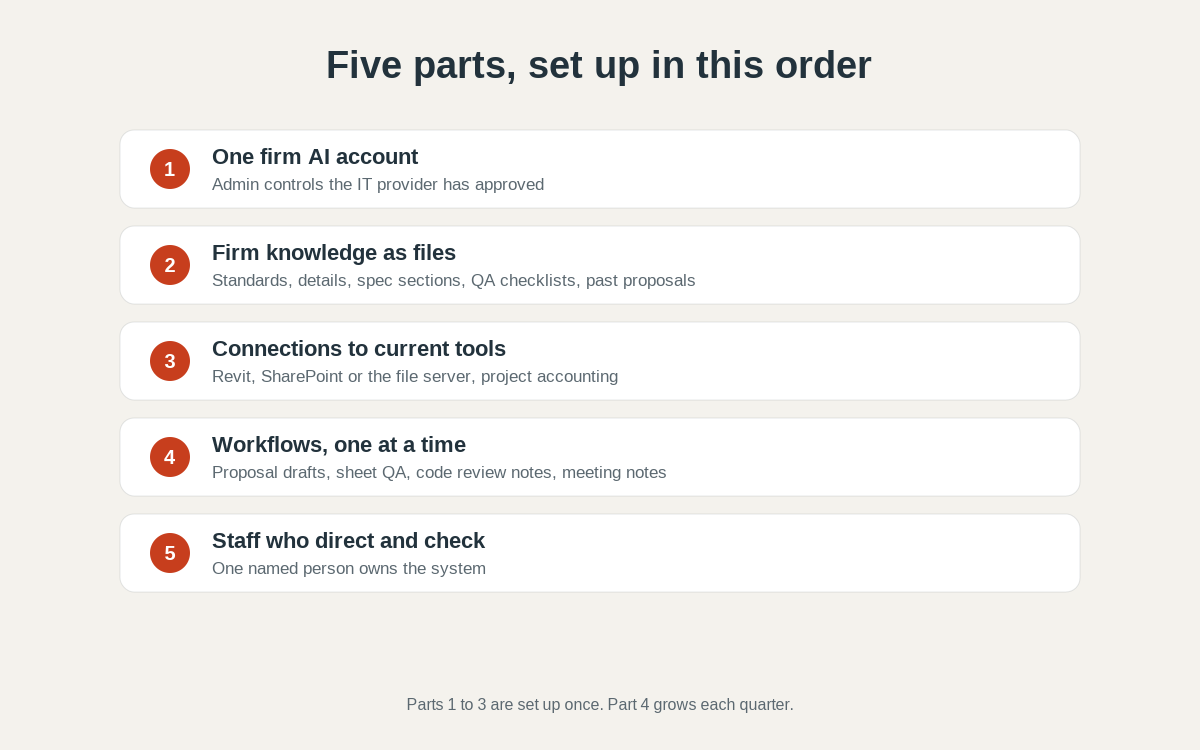
- The firm gets one AI account, such as Claude Enterprise, ChatGPT Enterprise or Copilot, with admin controls the IT provider has approved.
- The firm's standards, details, spec sections, QA checklists and past proposals are loaded as its own files. They carry over if the firm changes AI vendors.
- The account is connected to the tools staff already use. Switchgear, our Revit connector, covers Revit, and the file server or SharePoint comes next.
- Workflows are added one at a time, such as a proposal draft from past proposals or a sheet check before an issue. We measure each one in hours.
- Staff learn to direct the work and check it, and one named person owns the system.
The first three parts are set up once. The fourth grows each quarter, and a product from another vendor can join there as one more workflow on a system the firm already runs.
We build the software as well as advise on it. For a mechanical engineering firm we built a plumbing takeoff tool that extracted 237 pipe segments from a single sheet, with lengths and sizes, for the engineer to review.
How roles change
The Anthropic report includes a figure of roles that broadened, such as a product manager, a designer and an engineer becoming one builder. The examples below are ours, for a regional firm.
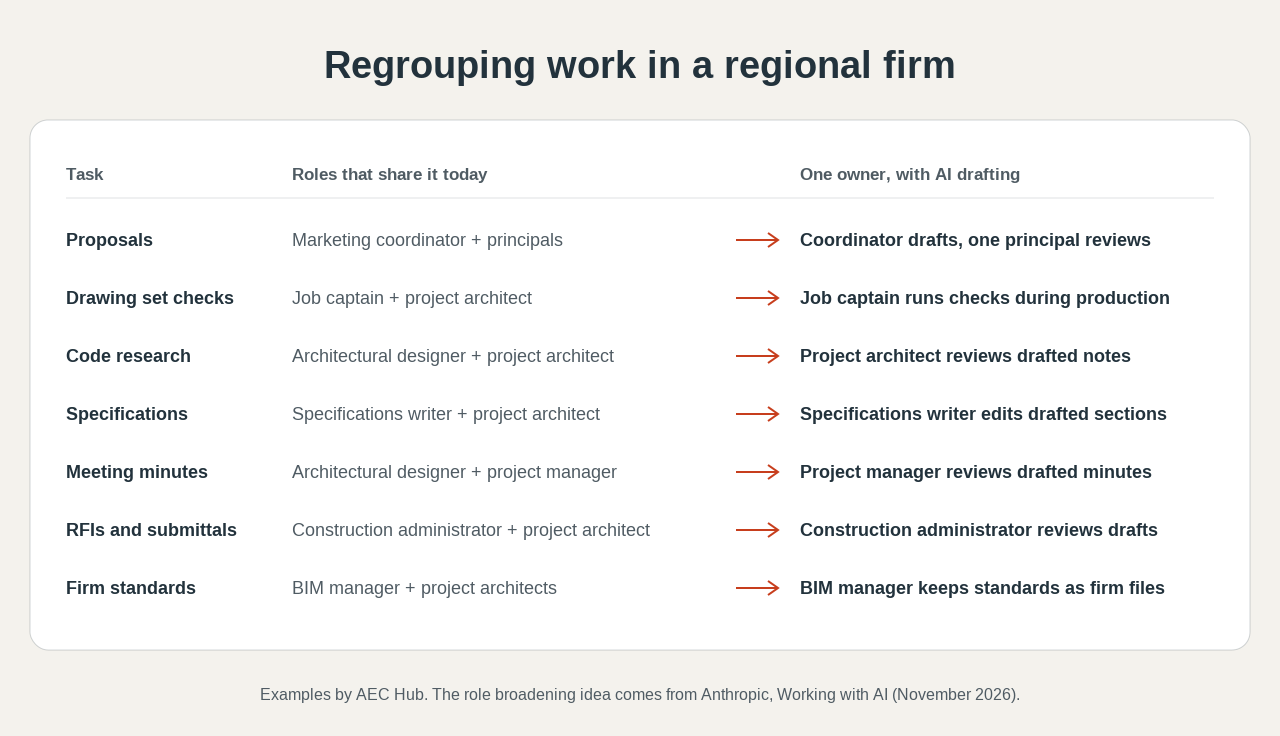
The table below adds five tasks to those seven and lists them in project order, from pursuit to construction. For each task it names the owner, the files the AI drafts from and what the owner checks before the work goes out.
| Task | Owner | The AI drafts from | The owner checks |
|---|---|---|---|
| Go or no-go on an RFQ | Principal | The RFQ and the firm's past pursuits for similar clients | The fit with the firm's experience and available staff |
| Proposals | Marketing coordinator | The RFQ, past proposals, resumes and project sheets | That every requirement is answered and every project fact is correct |
| Fee estimates | Project manager | Hours from past projects of the same type and size | The scope differences from those past projects |
| Code research | Project architect | The adopted codes and the project's occupancy, area and construction type | Each cited section against the code text |
| Detail search | Architectural designer | Details from the firm's past projects | That the detail fits this project's assembly |
| Drawing set checks | Job captain | The Revit model and the firm's QA checklist | Each flagged sheet, view and tag |
| Specifications | Specifications writer | The firm's master sections and the project's products | Product selections and agreement with the drawings |
| Meeting minutes | Project manager | The meeting transcript | Decisions, owners and dates |
| RFIs and submittals | Construction administrator | The contract documents and the RFI or submittal | The response against the drawings and specifications |
| Field reports and punch lists | Construction administrator | Site photos and voice notes | Each item and its location |
| Firm standards | BIM manager | The current standards, templates and project leads' redlines | Each standard with the project leads |
| Onboarding guides | Project lead | The firm's standards and a past project set | That the guide matches how the firm works today |
In a firm without a specifications writer or a construction administrator, the project architect owns those rows. In a firm without a BIM manager, the project architect who looks after the Revit template owns the firm standards row.
In each row the AI drafts and a person at the firm reviews and signs. Architects and engineers already work this way with junior staff: someone produces the drawing, and someone with more experience redlines it. One law firm in the report kept that training in place by having junior lawyers mark up the AI's first draft together with a senior attorney. A firm can do the same with a junior and a project architect on a drafted set of code notes.
The time that comes back goes to the tasks the report calls bottlenecks, which are review, client conversations and decisions. A construction company in the report had an AI agent collect the morning site updates and draft the daily report, and its project managers used those mornings to talk with customers.
The firm workbench
Every firm we work with has its own standards, its own software and its own connections between them. Most have no single place that holds the standards, the project data and the review steps together in a form an AI model can use. We call that place the firm's workbench. It holds parts two to four of the system above, which are the firm's files, the connections to its software and its workflows.
The first version of a workbench may contain no automation. It holds the current standards, the QA checklists and the proposal library, with a named owner for each and rules for who can change them. In technical terms it is a data lake, and someone at the firm has to govern it.
Workflows are then added one at a time, and these are two of them.
- A prospecting workflow finds RFQs and leads in the firm's markets, qualifies them against the firm's experience and records them for the marketing coordinator.
- A QA workflow reads the firm's standards, builds a checklist for each review gate and checks the drawing set against it. The project architect receives a set with the spelling, capitalization and tag errors already flagged, and spends the review on coordination and constructability.
A workbench is built from the firm's own standards and data, and it connects to the software the firm already uses. Its files and connections work with any AI model, so the firm can change vendors without rebuilding it.
A separate product for each task needs its own copy of the firm's standards, and each copy has to be kept current. With a workbench the standards are kept in one place, and a product from a vendor can read them there.
How we work with a firm
- The firm owns the account, the files and the workflows. We do not resell software.
- We start with a staff survey and an interview with each department, so the plan comes from the firm's own answers.
- We add one workflow at a time and record the hours before and after.
- We write a handoff at the end of every engagement, and we say so when a firm is not a fit.
The first step is a free 30-minute session about your firm's workflows and current tools. You can book a session or read about the services.
Frequently asked questions
- Why do architecture firms get stuck on AI implementation?
- Firms usually name capacity, and four specific gaps sit behind it. No one person owns AI, the firm's standards and past proposals are not in a form a model can read, staff use personal accounts the IT provider has not approved, and nobody has time set aside to check what the AI produces.
- What did Anthropic's Working with AI research find?
- Anthropic interviewed people at 58 US companies in 66 interviews. The uses they rated most valuable required changes to roles and processes. Workflow tools bought from vendors went out of date as models improved, and tools handed to staff without other changes helped a few people and left the rest of the company unchanged.
- Does adopting AI mean an architecture firm lays off staff?
- In Anthropic's interviews, 2 of 58 companies had seen AI fully remove a position and cost someone a job. The companies that got the most value broadened roles and moved people toward review, client conversations and decisions. In a firm, staff direct the work and check it, the way they check a junior's drawings.
- What does an AI system for a 30 to 150 person firm include?
- It has five parts set up in order: one firm AI account the IT provider has approved, the firm's standards and past proposals loaded as its own files, connections to Revit and the file server, workflows added one at a time, and staff trained to direct and check the work with one person who owns the system.
Get the next AEC tech analysis in your inbox
Original research on AEC tools, AI adoption, and industry data. Free, irregular cadence, easy unsubscribe.
Need help applying this to your firm?
We advise AEC firms on technology and AI strategy. Start with a free 30-minute AI strategy session: your workflows, the right tools, and quick wins you can act on.
Book a free AI strategy session